🌐 Global Navigation (Global Indexing)
Deutsch | Tiếng Việt | Español | العربية | English | Indonesian | 日本語 | Brazilian | Français | 한국어 | Hindi | 简体中文 | 繁體中文
Welcome to the Swiss Economic Report.
We provide sophisticated, data-driven insights into the global macro landscape to help you navigate the complexities of 2026. Your journey toward financial sovereignty begins here.

"Interconnectedness of global markets and strategic shifts in macroeconomic trends: Providing clear investment direction."
1. The Persistent Nature of Global Inflation
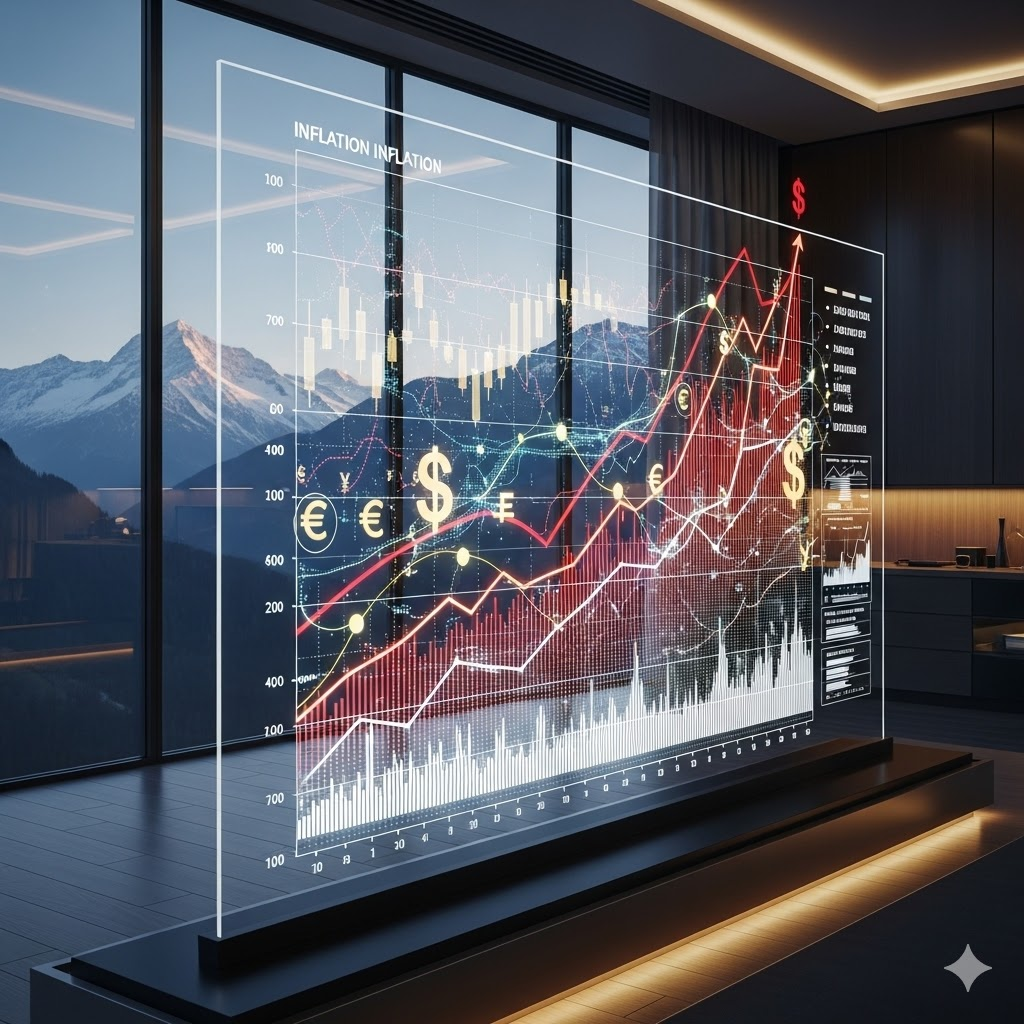
The global economy in 2026 is witnessing a unique phenomenon where traditional monetary tools are meeting new structural challenges. While the aggressive rate hikes of the past years have managed to bring down 'headline' inflation, the 'core' inflation—excluding volatile food and energy prices—is proving to be stickier than anticipated.
This persistence is largely attributed to a tight labor market and rising service costs, suggesting that the era of ultra-low inflation may be a thing of the past.

## Deep Dive: The Service Sector and Wage-Price Spiral
In 2026, we observe that the "Wage-Price Spiral" has become decentralized. AI-driven productivity is high, but the demand for skilled human labor in personalized services has kept wages resilient.
This creates a floor for inflation that central banks find difficult to penetrate without risking a deep recession. For wealth preservation, this means "Cash is no longer king" as its real value erodes faster than nominal interest rates can compensate.
2. Geopolitical Shifts and the New Baseline
We must recognize that the current inflation is not merely a monetary issue but a result of shifting global power dynamics. The transition from globalization to 'friend-shoring' has inevitably led to higher production costs.
As supply chains are restructured for resilience rather than just efficiency, the baseline for global prices has shifted upward. For investors, this means that real interest rates are likely to stay higher for a longer period, fundamentally changing the valuation models for all asset classes.
## 📊 2026 Global Inflation Benchmark & Target Rates
| Economic Zone | 2026 Target Rate | Projected Core CPI | Strategic Bias |
|---|---|---|---|
| North America | 2.0% | 3.1% - 3.4% | Neutral/Tight |
| Eurozone | 2.0% | 2.6% - 2.9% | Dovish Tilt |
| Asia-Pacific | Variable | 1.8% - 4.5% | Growth Focused |
3. Strategic Outlook for Future Economic Growth
Despite these inflationary pressures, certain sectors are showing robust growth potential driven by technological integration. The synergy between AI-driven productivity gains and the green energy transition is creating new pockets of value in the global market.
However, the gap between economies that successfully adapt to these macro trends and those that do not will continue to widen. A sophisticated macro analysis is essential for identifying these diverging paths and securing wealth in this new economic era.
🧠 2026 Wealth Intelligence Quiz (No. 2)
Q: What is the primary reason 'Core' inflation is proving to be stickier than 'Headline' inflation in 2026?
A) Sudden drops in global energy prices.
B) Tight labor markets and resilient service costs.
C) Over-reliance on traditional globalization models.

[Click to reveal the Answer]
Answer: B) While Headline inflation follows commodity prices, Core inflation is driven by structural labor shortages and service-sector resilience, making it harder to control via interest rates alone.
[Disclaimer]: The information provided in the Swiss Economic Report is for educational purposes only and does not constitute financial advice. Please consult with a licensed professional before making any investment decisions.


🌐 Global Navigation (Global Indexing)
Deutsch | Tiếng Việt | Español | العربية | English | Indonesian | 日本語 | Brazilian | Français | 한국어 | Hindi | 简体中文 | 繁體中文
🌐 [Global Search Terms]
1. German: Globale Inflationstrends und Wirtschaftsausblick 📊
2. Vietnamese: Xu hướng Lạm phát Toàn cầu và Triển vọng Kinh tế 📊
3. Spanish: Tendencias de Inflación Global y Perspectiva Económica 📊
4. Arabic: اتجاهات التضخم العالمي والتوقعات الاقتصادية 📊
5. English: Global Inflation Trends and Economic Outlook 📊
6. Indonesian: Tren Inflasi Global dan Proyeksi Ekonomi 📊
7. Japanese: 世界のインフレ動向と今後の経済見通し 📊
8. Chinese(S): 全球通胀趋势与经济展望 📊
9. Chinese(T): 全球通脹趨勢與經濟展望 📊
10. Brazilian: Tendências de Inflação Global e Perspectiva Econômica 📊
11. French: Tendances de l'inflation mondiale et perspectives économiques 📊
12. Korean: 글로벌 인플레이션 추세와 미래 경제 전망 📊
13. Hindi: वैश्विक मुद्रास्फीति रुझान और आर्थिक दृष्टिकोण 📊
If this report was helpful, please [Subscribe] for more high-density financial insights.
Thank you for reading the Swiss Economic Report. We build legacies together.