🌐 Global Navigation (Global Indexing)
Deutsch | Tiếng Việt | Español | العربية | English | Indonesian | 日本語 | Brazilian | Français | 한국어 | Hindi | 简体中文 | 繁體中文
🌐 Global Economy Quiz

Before diving into today's deep analysis, let's test your financial knowledge with a quick quiz.
Question: The Strait of Hormuz is a vital maritime chokepoint. Approximately what percentage of the world's total oil consumption passes through this strait daily?
a) 5% b) 12% c) 20% d) 35%
(Check the answer at the bottom!)

Stacks of resilient, warmly glowing pure gold bars stand firm in the foreground, representing ultimate monetary security. The background depicts the systemic crisis: a stylized, turbulent Strait of Hormuz conflict with dark-red waves crashing around ancient shipping vessels.
Above the chaotic sea, smoke and downward-trending financial market graphs merge, symbolizing the geopolitical energy shock and the resulting collapse of trust in fiat currency. No text is present.
(The Core: Strategic Analysis of Gold, Hormuz Crisis, and Global Wealth)
The global financial landscape is currently navigating through one of the most tumultuous periods of the decade. As of March 2026, the convergence of profound geopolitical instability in the Middle East and a structural failure of global currency trust has catapulted the price of Gold (XAU/USD) to an unprecedented record of $5,300 per ounce.
The central catalyst, which was initially perceived as a localized conflict, is the potential or partial blockade of the Strait of Hormuz by Iranian forces. This marítima chokepoint, through which nearly 20% of global daily oil consumption passes, is the singular thread upon which the global energy supply hangs. The market’s reaction is not merely emotional; it is a rational and strategic migration of wealth into the ultimate, unconfiscatory asset of last resort.
## 1. The Geopolitical Domino: Hormuz Crisis and Energy Shockwave
The Middle East crisis, spearheaded by the escalating Iranian situation, has transcended rhetoric and targeted critical infrastructure. The primary fear gripping global markets is the complete blockade of the Strait of Hormuz. A shutdown of this waterway would instantaneously remove approximately 18 million barrels of oil daily from the global supply. This would not be a mere "price shock"; it would be an energy catastrophe.
The United States Dollar (USD), traditionally the pricing currency for oil (Petrodollar), is finding itself ironically weakened by the resulting inflation. If the petrodollar recycling mechanism is broken because energy cannot be shipped, the fundamental pillars of US dollar dominance are threatened. Investors have quickly identified that while energy prices are soaring, the purchasing power of their currency is collapsing. The flight to gold is a flight away from a currency that is being eroded by both debt and energy-driven hyperinflation.
## 2. Structural Breakdown of Trust in Central Banks and Fiat
The surge to $5,300 gold is a systemic vote of no confidence. Central banks globally, particularly in developed nations (Fed, ECB, BoJ), have exhausted their monetary tools. Faced with stagflation, they are unable to raise rates to fight inflation without triggering a massive debt service crisis, nor can they lower rates or engage in more quantitative easing (QE) without further eroding the currency.
Markets have realized that fiat currencies are trapped. The unprecedented levels of global debt can only be managed through a structured debasement of the currency (inflation). Investors have rationally concluded that the only way to protect purchasing power is to hold assets that cannot be printed. Gold cannot be printed, nor can its value be decreed away by a central bank.
| Metric (March 2026) | Data Point | Implication for Gold |
| Gold Price (XAU/USD) | $5,300/oz | Unprecedented High. Ultimate safe haven demand. |
| Hormuz Daily Oil Traffic | ~18 Million Barrels | Single thread of global energy supply. Systemic Risk. |
| Global Debt-to-GDP | >350% | Structural debt trap. Debasement (Inflation) is the only option. |
| Central Bank Trust Index | Record Low | Systemic transition to decentralized assets. |
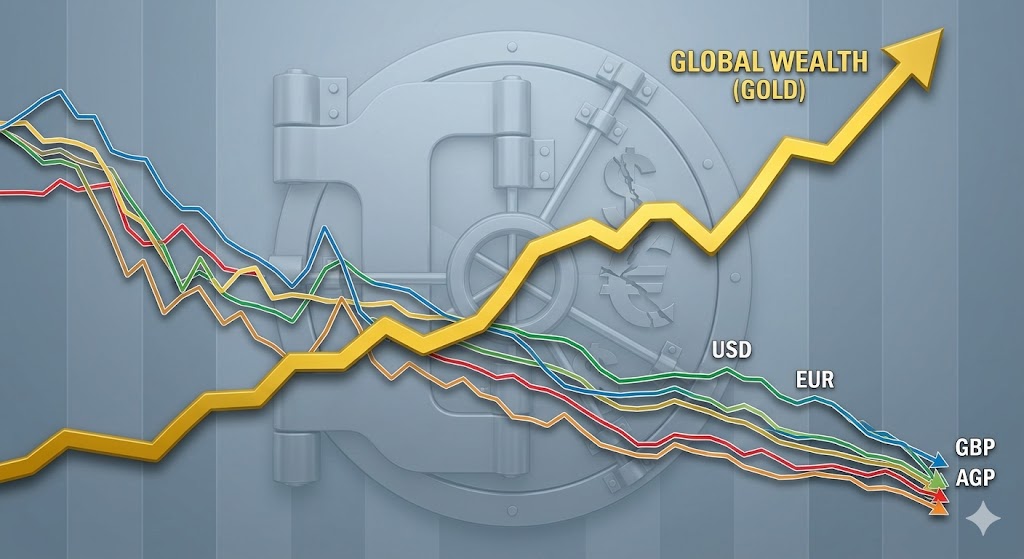
A detailed financial terminal style graph in a 1:1 ratio, showing a structural market shift. A thick, bright gold line labeled "GLOBAL WEALTH (GOLD)" dramatically trends upward. In contrast, several other lines (USD, EUR, GBP) are trending steeply downward, converging at the bottom right. The background features a large, transparent vault symbol, overlaid with fractured fiat currency symbols ($, €), illustrating the debasement of paper money and the migration to real assets. The overall authority is that of professional economic analysis. No text is present on the visual itself.
🌐 Global Navigation (Global Indexing)
Deutsch | Tiếng Việt | Español | العربية | English | Indonesian | 日本語 | Brazilian | Français | 한국어 | Hindi | 简体中文 | 繁體中文
## 3. The Central Bank Paradox: Aggressive Gold Buying While Preaching Fiat Stability
While central banks continue to issue statements assuring market participants of the stability of fiat currencies and the temporary nature of inflation, their actions tell a completely different story. Global central banks, especially those of BRICS nations (Brazil, Russia, India, China, and South Africa) and other emerging economies, have been aggressively accumulating physical gold reserves at a rate not seen since the Bretton Woods era.
Why? Because they know the current dollar-centric monetary system is in a late-stage collapse. By holding gold, they are preparing for a monetary reset where a multi-polar currency system might be partially backed by real assets. Investors are observing these actions, not the rhetoric, and the signal is clear: hold real assets, not paper assets.
## 4. Operationalizing 'Crisis Investing': Turning Fear into Financial Freedom
For the astute investor, geopolitical fear is not a reason to panic, but a profound opportunity to execute a structured leveraged strategy of wealth multiplication. In a crisis, liquidity is often sacrificed first, but gold always retains its value and liquidity. The current surge to $5,300 is only the initial phase. The real, compounding profits lie not just in holding physical gold, but in utilizing sophisticated, asymmetric risk/reward instruments.
This includes high-quality gold mining equities and strategic options contracts. This approach transforms a reactive portfolio (one that simply protects) into an active portfolio (one that aggressively grows). The mission is to protect capital from debasement and simultaneously capture massive, once-in-a-generation asymmetric profits. This is not "crisis investing"; it is mastery of the monetary environment.
## 5. Conclusion: Protecting Your Digital Territory and Securing Future Generations
The road to $5,300 gold, catalyzed by the Strait of Hormuz crisis and the systemic failure of the fiat monetary system, is not a transitory event. It is a fundamental, generational reset. The mission is unambiguous: protect your financial future. This requires a transition from paper assets that can be inflated away into real assets with zero counterparty risk. Gold is the ultimate decentralized asset, the permanent store of value.
The Hormuz crisis might eventually dissipate, but the monetary damage is irreversible. We are not just defending our current capital; we are building a permanent digital territory and securing an unconfiscatory legacy for future generations. Swiss Economic Report is committed to being your reliable compass in this turbulent, yet profitable, journey.
"If this report was helpful for your financial insight, please click [Subscribe] to join our journey toward financial freedom!"
🚀 Quiz Answer & Genius Insight
Correct Answer: c) 20%
Genius Insight: The Strait of Hormuz is the world's singular maritime chokepoint. While other chokepoints like the Suez or Panama Canals handle significant global trade, the Strait of Hormuz is uniquely concentrated with approximately 20% of global daily oil consumption, including nearly all oil shipped from the world's most vital energy producers (Saudi Arabia, Iraq, UAE, Qatar, Kuwait, Iran).
There are no immediate, high-volume pipeline or shipping alternatives to bypass the Strait. Its blockade would not just be an oil price shock; it would be a total, immediate, and irreversible energy catastrophe. Investors recognize this. Hold Gold as the ultimate, decentralized hedge against energy hyperinflation and systemic supply chain failure.
🛡️ (Disclaimer)
Please note: All content in this report is provided for informational and educational purposes only and should not be considered investment advice.
The unique strategy of asymmetric wealth creation from geopolitical events requires specialized knowledge and meticulous execution.
As with any investment strategy, we recommend that readers perform their own due diligence and consult with a professional financial advisor before executing any strategic leverage plans.


"May your day be as clear and serene as the fresh air of the Swiss Alps. For your financial freedom and peace of mind, Swiss Economic Report will always be here as your reliable compass. Thank you for visiting."
🌐 Global Navigation (Global Indexing)
Deutsch | Tiếng Việt | Español | العربية | English | Indonesian | 日本語 | Brazilian | Français | 한국어 | Hindi | 简体中文 | 繁體中文
🌏[Genius Team] Global 13-Language SEO Deployment
- 🇩🇪 German (German):
- Title: Report Nr. 26: Hormuz-Krise, Gold auf 5.300 $, Währungsverfall-Realität.
- Keywords: Goldpreis, Strait of Hormuz, Irankrise, Währungsverfall, Inflation, Hyperinflation, Sichere Häfen, Zentralbanken, BRICS, Asymmetrische Strategie, leveraged Strategy.
- 🇻🇳 Vietnamese (Vietnamese):
- Title: Báo cáo số 26: Khủng hoảng Hormuz, Vàng đạt 5.300$, Thực tế mất giá tiền tệ.
- Keywords: Giá vàng, Eo biển Hormuz, Khủng hoảng Iran, Mất giá tiền tệ, Lạm phát, Lạm phát phi mã, Tài sản trú ẩn an toàn, Ngân hàng trung ương, BRICS, Chiến lược bất đối xứng, leveraged Strategy.
- 🇲🇽 Spanish (Latin America):
- Title: Reporte No. 26: Crisis Hormuz, Oro en 5,300$, Realidad Devaluación Monetaria.
- Keywords: Precio del oro, Estrecho de Hormuz, Crisis de Irán, Devaluación monetaria, Inflación, Hiperinflación, Activos de refugio seguro, Bancos centrales, BRICS, Estrategia asimétrica, leveraged Strategy.
- 🇸🇦 Arabic:
- Title: التقرير رقم 26: أزمة هرمز، الذهب يبلغ 5300 دولار، واقع تراجع العملة.
- Keywords: سعر الذهب, مضيق هرمز, أزمة إيران, تراجع العملة, التضخم, التضخم المفرط, أصول المलाذ الآمن, البنوك المركزية, بريكس, الاستراتيجية غير المتماثلة, leveraged Strategy.
- 🇺🇸 English:
- Title: Report No. 26: Hormuz Crisis, Gold at $5,300, Systemic Debasement of Fiat.
- Keywords: Gold Price, Strait of Hormuz, Iran Crisis, Debt Hyperinflation, Inflation, Stagflation, Safe Haven, Decentralized Asset, Central Banks, BRICS, Asymmetric Risk, leveraged Strategy.
- 🇮🇩 Indonesian:
- Title: Laporan No. 26: Krisis Hormuz, Emas di $5.300, Realitas Penurunan Nilai Mata Uang.
- Keywords: Harga Emas, Selat Hormuz, Krisis Iran, Penurunan Nilai Mata Uang, Inflasi, Hiperinflasi, Aset Safe Haven, Bank Sentral, BRICS, Strategi Asimetris, leveraged Strategy.
- 🇯🇵 Japanese:
- Title: レポートNo. 26:ホルムズ危機、金価格5,300ドル、貨幣価値下落の現実。
- Keywords: 金価格, ホルムズ海峡, イラン危機, 貨幣価値下落, インフレ, ハイパーインフレ, 安全資産, 中央銀行, BRICS, 非対称戦略, leveraged Strategy.
- 🇨🇳 Chinese (Simplified):
- Title: 第26号报告:霍尔木兹危机、金价5300美元、货币贬值现实。
- Keywords: 金价, 霍尔木兹海峡, 伊朗危机, 货币贬值, 通货膨胀, 恶性通货膨胀, 避险资产, 中央银行, 金砖国家, 非对称战略, leveraged Strategy.
- 🇹🇼 Chinese (Traditional):
- Title: 第26號報告:霍爾木茲危機、金價5300美元、貨幣貶值現實。
- Keywords: 金價, 霍爾木茲海峡, 伊朗危機, 貨幣貶值, 通貨膨脹, 惡性通貨膨脹, 避險資產, 中央銀行, 金磚國家, 非對稱策略, leveraged Strategy.
- 🇧🇷 Portuguese (Brazil):
- Title: Relatório No. 26: Crise Hormuz, Ouro em $5.300, Realidade Desvalorização Monetária.
- Keywords: Preço do ouro, Estreito de Hormuz, Crise do Irã, Desvalorização monetaria, Inflação, Hiperinflación, Ativos de refúgio seguro, Bancos centrais, BRICS, Estratégia assimétrica, leveraged Strategy.
- 🇫🇷 French:
- Title: Rapport N° 26: Crise Hormuz, l'Or à 5 300 $, Réalité Dévaluation Monétaire.
- Keywords: Prix de l'or, Détroit d'Hormuz, Crise iranienne, Dévaluation monétaire, Inflation, Hyperinflation, Actifs de refuge sûr, Banques centrales, BRICS, Stratégie asymétrique, leveraged Strategy.
- 🇰🇷 Korean:
- Title: 리포트 26호: 호르무즈 위기, 금 5,300달러 돌파, 화폐 가치 하락의 현실.
- Keywords: 금값, 호르무즈 해협, 이란 위기, 화폐 가치 하락, 인플레이션, 초인플레이션, 안전자산, 중앙은행, BRICS, 비대칭 전략, leveraged Strategy.
- 🇮🇳 Hindi:
- Title: रिपोर्ट नंबर 26: होर्मुज़ संकट, सोना $5,300 पर, मुद्रा अवमूल्यन वास्तविकता।
- Keywords: सोने की कीमत, होर्मुज़ जलडमरू मध्य, ईंधन संकट, मुद्रा अवमूल्यन, मुद्रास्फीति, अति-मुद्रास्फीति, सुरक्षित संपत्ति, केंद्रीय बैंक, ब्रिक्स, असममित रणनीति, leveraged Strategy.
고효율 해시태그