[Global Indexing: 13 Languages Navigation]
- English | 2. Deutsch | 3. Tiếng Việt | 4. Español | 5. العربية | 6. Bahasa Indonesia | 7. 日本語 | 8. Português | 9. Français | 10. 한국어 | 11. हिन्दी | 12. 简体中文 | 13. 繁體中文

🌐 Global Economy Quiz
"What is the term for a debt investment that is not made on the public market (like stocks or bonds) but is instead negotiated directly between a lender and a borrower?"

A) Public Equity B) Private Credit C) Venture Capital D) Mutual Funds
(Check the answer at the bottom!)
The Great Rotation: Beyond the AI Hype
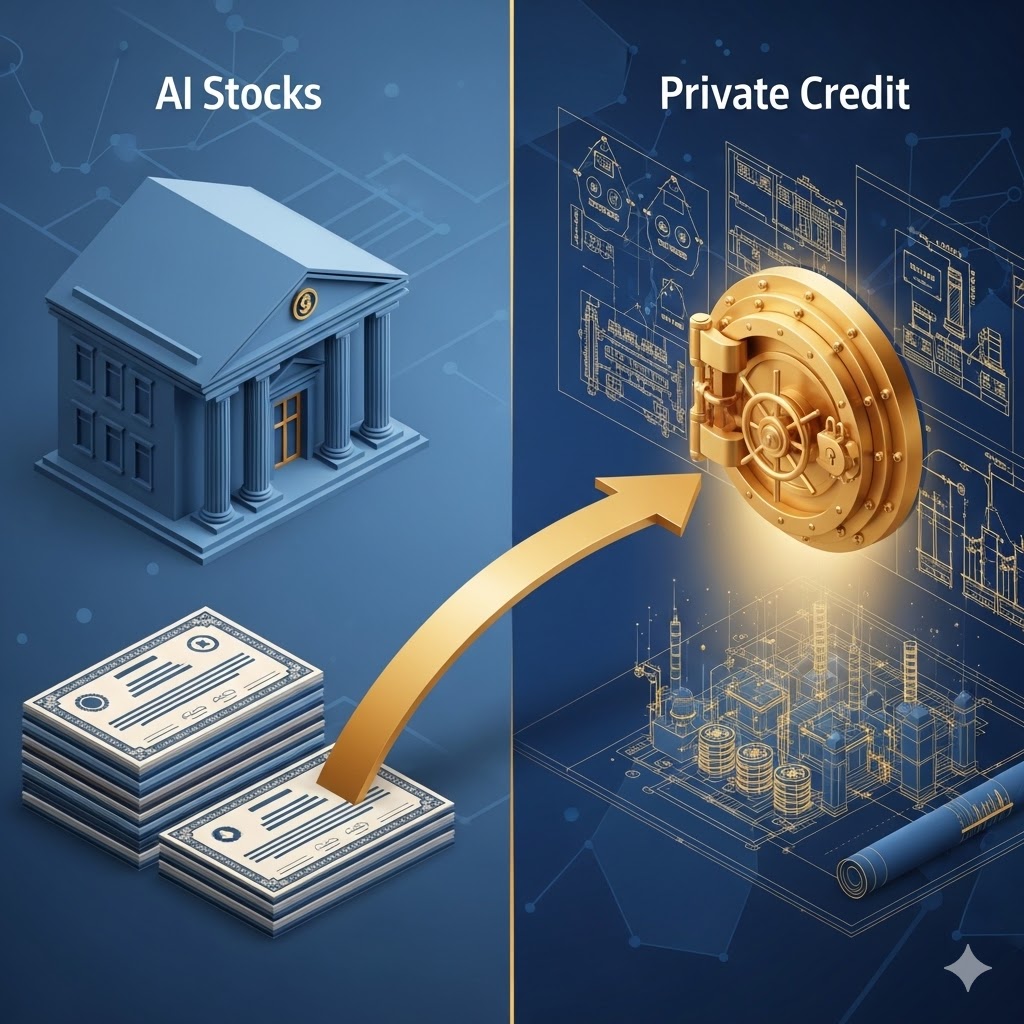
While retail investors are busy chasing the latest Artificial Intelligence breakthroughs, a silent but massive shift is occurring in the upper echelons of Wall Street. The world’s most sophisticated institutional investors—pension funds, sovereign wealth funds, and ultra-high-net-worth individuals—are pivoting away from volatile tech equities toward a more robust, income-generating asset class known as Private Credit.
The reason is simple yet profound: Stability and Yield. In an era of unpredictable inflation and shifting interest rate regimes, the promise of "growth at any cost" in the AI sector is being replaced by the necessity of "certainty of return." Private credit offers exactly that—a senior-secured position in the capital stack with floating-rate coupons that act as a natural hedge against rising costs.
[The Definitive Answer]
💡 Wall Street insiders are buying Private Credit because it offers "Equity-like returns with Debt-like security." While AI stocks are priced for future perfection, Private Credit provides immediate, contractual cash flow secured by the physical assets of the companies. In a volatile market, owning the "Right to be Paid First" is the ultimate luxury.
[Global Indexing: 13 Languages Navigation]
- English | 2. Deutsch | 3. Tiếng Việt | 4. Español | 5. العربية | 6. Bahasa Indonesia | 7. 日本語 | 8. Português | 9. Français | 10. 한국어 | 11. हिन्दी | 12. 简体中文 | 13. 繁體中文
1. The Three Omens of the AI Bubble Fatigue
Why now? The enthusiasm for AI stocks is facing three critical headwinds that "insiders" can no longer ignore:
- Valuation Disconnect: Many AI leaders are trading at multiples that assume decades of flawless execution, leaving zero margin for error.
- Monetization Lag: While the technology is revolutionary, the timeframe for these companies to generate massive, sustainable Cash Flow is longer than the market expects.
- Infrastructure Bottlenecks: The true winners are not just the software developers, but the physical infrastructure providers—power grids and data centers—which require Debt Financing, not just equity hype.
2. The Secret Identity of 'This' Asset: Private Credit
Private Credit involves non-bank lenders providing loans directly to companies. Unlike publicly traded bonds, these are bespoke agreements that often come with higher interest rates and stronger protections (covenants). For a Wall Street insider, it’s the difference between "hoping for a stock to go up" and "knowing you are first in line to get paid."
### The Institutional Shift: Why Banks are Retreating
To understand the rise of Private Credit, we must look at the regulatory landscape of 2026. Following the implementation of Basel IV capital requirements, traditional commercial banks have significantly pulled back from mid-market corporate lending to preserve their own capital ratios. This has created a "Lending Gap" that private funds are now filling.
Unlike banks, private credit funds do not take deposits and are not subject to the same systemic risk regulations, allowing them to offer Higher Flexibility and Faster Execution for borrowers, while delivering Premium Yields (typically 400-600 basis points over SOFR) to investors. This is not a temporary trend; it is a fundamental restructuring of the global financial plumbing.
3. Comparative Analysis: AI Stocks vs. Private Credit
To understand why the smart money is moving, let’s look at the risk-reward profile:
| Feature | AI Stocks (Equity) | Private Credit (Debt) |
| Primary Goal | Capital Appreciation | Consistent Income (Yield) |
| Risk Level | High (Market Volatility) | Moderate (Senior Secured) |
| Income Type | Dividends (Variable) | Interest (Floating Rate) |
| Inflation Hedge | Indirect | Direct (Floating Rates) |
| Exit Strategy | Market Timing | Maturity/Refinancing |
| Asset Class | Target Return (Net) | Volatility | Security Level | Liquidity |
| S&P 500 (Equity) | 8-10% | High | Low (Residual) | Daily |
| High Yield Bonds | 6-8% | Moderate | Moderate | Moderate |
| Private Credit (Senior) | 9-12% | Low | High (1st Lien) | Low (3-5 yrs) |
| Cash (Savings) | 3-4% | Zero | Guaranteed |
If you want to invest like a Swiss asset manager, follow these five strategic pillars:
- Focus on Seniority: Always prioritize "Senior Secured" positions to ensure you are at the top of the repayment hierarchy.
- Diversification via Infrastructure: Look for credit funds that finance AI Infrastructure (Data Centers) rather than AI software.
- Evaluate the Manager: In private markets, the quality of the "GP" (General Partner) is everything. Track record is non-negotiable.
- Floating Rate Advantage: Ensure the loans have floating rates to capture gains when central banks hold rates higher for longer.
- Patience as a Virtue: Understand that these are Illiquid Assets. You are trading liquidity for a significant Complexity Premium.

Conclusion: The Future of Wealth Preservation
The 2020s will not be remembered for who picked the best stock, but for who built the most resilient Asset Defense strategy. By incorporating Private Credit alongside your growth assets, you transition from a "speculator" to an "architect of wealth." Wall Street insiders aren't abandoning technology; they are simply choosing to own the Lien on the building rather than a Ticket to the lottery.
📊 [Report No. 40] Today’s Key Summary
- The Shift: Insiders are moving from volatile AI equities to stable Private Credit.
- The Reason: Private Credit offers senior security and floating-rate yields that hedge against inflation.
- The Warning: AI stocks face valuation bubbles and monetization delays, making them risky for pure defense.
- The Strategy: Focus on Infrastructure-linked debt (Data Centers, Power) for the best risk-adjusted returns.
- The Action: Diversify into illiquid, high-yield private markets to capture the "Complexity Premium."
🚀 Quiz Answer & Genius Insight
Answer: B) Private Credit Genius Insight:

In a high-interest-rate environment, being the Lender is often more profitable than being the Owner.
While the world watches the stock ticker, the truly wealthy are collecting the interest payments that keep those companies running.
Disclaimer: This report is for informational purposes only and does not constitute financial advice. Investing involves risk. Always consult with a professional advisor.
🌐 Data Sources & References.
- Market Data: Bloomberg Terminal (Private Debt Index), Preqin Global Alternatives Report 2026.
- Regulatory Insight: Bank for International Settlements (BIS) - Basel IV Implementation Monitoring.
- Institutional Strategy: BlackRock Private Markets Outlook, Goldman Sachs Asset Management Research.
- Economic Indicators: IMF World Economic Outlook, Federal Reserve Board (Z.1 Release).
If this article was helpful, please click [Subscribe]!
Recommended Reading
[Report No. 39] The 'One Thing' Wall Street Insiders Are Buying Right Now (And It's Not AI Stocks)
🌐 Global Indexing Access (Interactive Anchor Links)[DE] Deutsch | [FR] Français | [IT] Italiano | [ES] Español | [PT] Português | [RU] Русский | [ZH-CN] 简体中文 | [ZH-TW] 繁體中文 | [JP] 日本語 | [AR] العربية | [HI] हि
swiss-report.tistory.com
[Report No. 38] "The Secret Portfolio of 1% Global Elite: Top 3 ETFs to Watch in 2026"
🌐 Global Navigation: Select Your LanguageClick the language below to jump directly to the report in your native tongue.English (Main) | Deutsch | Français | Español | Português | Italiano | Türkçe | Русский | 简体中文 | 繁體中文 |
swiss-report.tistory.com
[Report No. 37] The End of AI Hype? 3 Stocks to Watch After the Bubble.
🌐 Global Indexing: Multi-Language Access[English] | [Deutsch] | [Français] | [Español] | [Português] | [Italiano] | [Nederlands] | [简体中文] | [繁體中文] | [日本語] | [한국어] | [Tiếng Việt] | [हिन्दी]🌐 Global Econom
swiss-report.tistory.com

"May your day be as clear and serene as the fresh air of the Swiss Alps.
For your financial freedom and peace of mind, Swiss Economic Report will always be here as your reliable compass.

Thank you for visiting."
[Global Indexing: 13 Languages Navigation]
English | 2. Deutsch | 3. Tiếng Việt | 4. Español | 5. العربية | 6. Bahasa Indonesia | 7. 日本語 | 8. Português | 9. Français | 10. 한국어 | 11. हिन्दी | 12. 简体中文 | 13. 繁體中文
🌐 Global SEO: 13 Languages Multi-Layer Strategy
- Deutsch
- Title: Warum Insider von der Wall Street 'Private Credit' statt KI-Aktien kaufen
- Summary: Erfahren Sie, warum institutionelle Anleger von volatilen Tech-Aktien zu stabilen Privatkrediten wechseln.
- Keywords: Private Credit, KI-Aktien, Wall Street, Vermögensschutz, Inflation.
- Tiếng Việt
- Title: Tại sao giới chuyên gia Wall Street chọn 'Tín dụng Tư nhân' thay vì cổ phiếu AI
- Summary: Khám phá lý do tại sao các nhà đầu tư tổ chức đang chuyển từ cổ phiếu công nghệ sang tín dụng tư nhân ổn định.
- Keywords: Tín dụng tư nhân, Cổ phiếu AI, Wall Street, Bảo vệ tài sản, Lạm phát.
- Español (Latín)
- Title: Por qué los expertos de Wall Street compran 'Crédito Privado' en lugar de acciones de IA
- Summary: Descubra por qué los inversores institucionales están rotando de acciones tecnológicas a crédito privado estable.
- Keywords: Crédito Privado, Acciones de IA, Wall Street, Defensa de Activos, Inflación.
- العربية
- Title: لماذا يشتري خبراء وول ستريت 'الائتمان الخاص' بدلاً من أسهم الذكاء الاصطناعي
- Summary: اكتشف لماذا ينتقل المستثمرون المؤسسيون من الأسهم التقنية المتقلبة إلى الائتمان الخاص المستقر.
- Keywords: الائتمان الخاص، أسهم الذكاء الاصطناعي، وول ستريت، الدفاع عن الأصول، التضخم.
- English
- Title: Why Wall Street Insiders Are Buying 'Private Credit' Instead of AI Stocks
- Summary: Learn why institutional investors are shifting from volatile tech stocks to stable private credit.
- Keywords: Private Credit, AI Stocks, Wall Street, Asset Defense, Inflation Hedge.
- Indonesian
- Title: Mengapa Insider Wall Street Membeli 'Kredit Swasta' Alih-alih Saham AI
- Summary: Pelajari mengapa investor institusi beralih dari saham teknologi yang volatil ke kredit swasta yang stabil.
- Keywords: Kredit Swasta, Saham AI, Wall Street, Pertahanan Aset, Inflasi.
- 日本語
- Title: ウォール街のインサイダーがAI株ではなく「プライベート・クレジット」を買う理由
- Summary: 機関投資家がボラティリティの高いハイテク株から安定したプライベート・クレジットに移行している理由を解説。
- Keywords: プライベート・クレジット, AI株, ウォール街, 資産防衛, インフレ。
- 简体中文
- Title: 为什么华尔街内部人士购买“私人信贷”而非人工智能股票
- Summary: 了解机构投资者为何从波动较大的科技股转向稳定的私人信贷。
- Keywords: 私人信贷, 人工智能股票, 华尔街, 资产防御, 通货膨胀。
- 繁體中文
- Title: 為什麼華爾街內部人士購買「私人信貸」而非人工智能股票
- Summary: 了解機構投資者為何從波動較大的科技股轉向穩定的私人信貸。
- Keywords: 私人信貸, 人工智能股票, 華爾街, 資產防禦, 通貨膨脹。
- Português (Brasil)
- Title: Por que especialistas de Wall Street estão comprando 'Crédito Privado' em vez de ações de IA
- Summary: Descubra por que investidores institucionais estão mudando de ações de tecnologia para crédito privado estável.
- Keywords: Crédito Privado, Ações de IA, Wall Street, Defesa de Ativos, Inflação.
- Français
- Title: Pourquoi les initiés de Wall Street achètent du 'Crédit Privé' plutôt que des actions IA
- Summary: Découvrez pourquoi les investisseurs institutionnels délaissent les actions tech volatiles pour le crédit privé stable.
- Keywords: Crédit Privé, Actions IA, Wall Street, Défense des Actifs, Inflation.
- 한국어
- Title: 월가 거물들이 AI 주식 대신 '프라이빗 크레딧'을 매집하는 결정적 이유
- Summary: 기관 투자자들이 왜 변동성 큰 기술주 대신 안정적인 사모 대출 시장으로 향하는지 분석합니다.
- Keywords: 프라이빗 크레딧, AI 주식, 월스트리트, 자산 방어, 인플레이션 헤지.
- हिन्दी
- Title: क्यों वॉल स्ट्रीट के दिग्गज एआई शेयरों के बजाय 'प्राइवेट क्रेडिट' खरीद रहे हैं
- Summary: जानें कि संस्थागत निवेशक अस्थिर टेक शेयरों से स्थिर निजी क्रेडिट की ओर क्यों जा रहे हैं।
- Keywords: प्राइवेट क्रेडिट, एआई स्टॉक, वॉल स्ट्रीट, एसेट डिफेंस, मुद्रास्फीति।